
Introduction
How InfoAnalytica combined sales intelligence, AI-assisted targeting and human-led SDR execution to generate high-quality, sales-ready leads for a partner program, matching each partner offer with the right businesses and decision-makers across the United States.
| Client | A leading technology provider’s partner program |
| Program | Qualified lead generation and partner introductions supporting partner-led customer acquisition among small and mid-sized businesses in the United States |
| Offer portfolio | Partner offers across data protection, automation, generative AI and data platforms |
| Target account universe | 100,000+ accounts |
| InfoAnalytica’s role | Offer study, account and contact intelligence and targeting, SDR outreach, lead qualification, partner introductions and campaign optimization |
| Differentiator | Sales intelligence and human-defined targeting expertise, applied consistently at scale with AI |
The Challenge
The client’s partner program offered several solutions to the same market, and InfoAnalytica had to turn them into qualified, partner-ready pipeline across more than 100,000 accounts.
- Different offers, different buyers. Some offers were relevant only to IT, privacy or customer service teams; others could interest leaders across business operations. Each needed a distinct buyer persona.
- Relevance that firmographics could not reveal. Companies of the same size and industry could need very different offers. What mattered was the current reason to act.
- A changing portfolio and demanding buyers. Offers were added and withdrawn mid-program, and decision-makers expected consultative conversations, not generic outreach.
Our Approach
InfoAnalytica ran the program as one operating model, combining human expertise, AI-assisted analysis and SDR execution.
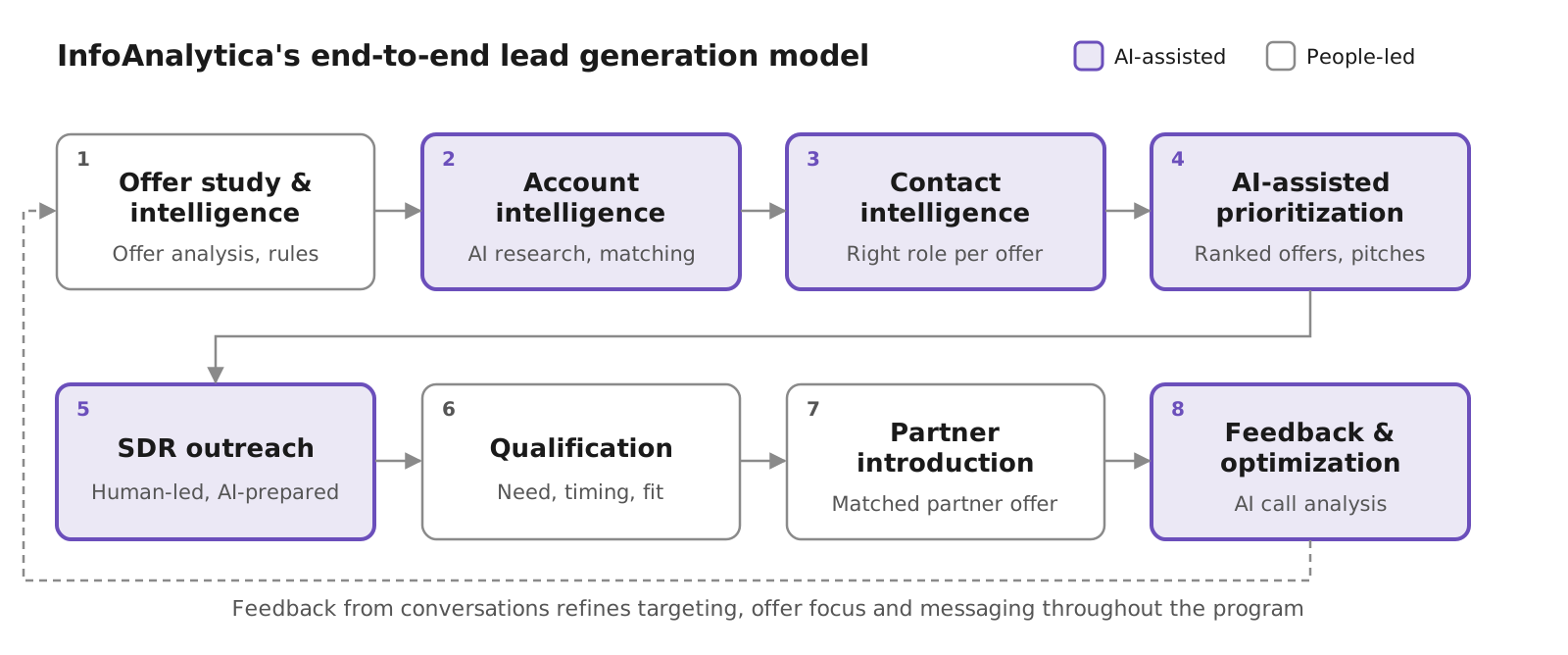
Figure 1. InfoAnalytica’s end-to-end lead generation model.
- Offer study and sales intelligence. Analysts studied every offer: the industries that need it, the roles that own the decision, the companies to exclude and the questions that should open a call. These findings became the targeting rules, such as judging each company’s own need rather than its clients’, and excluding companies that already compete in an offer’s area.
- AI-assisted account and contact intelligence. Directed by those rules, AI researched each account and contact from web, third-party and intent sources, classified the information and matched each to the most relevant offers, with a rationale for every recommendation.
- Prioritized, human-checked briefs. Researchers spot-checked the AI output. SDRs then received each account with ranked offers and a drafted opening pitch, and prepared through AI role-play mock calls.
- Human-led outreach and qualification. SDRs led every conversation, qualified prospects on need, timing and readiness, and introduced only qualified prospects to the matching partner, so partners received sales-ready conversations rather than contact lists. AI never contacted a prospect or made a qualification decision.
- Continuous optimization. AI analysis of calls captured market feedback and follow-up opportunities, and matching errors were analyzed and corrected. For example, when interest in automation offers came mostly from office and administrative staff, targeting widened to those roles. When prospects hesitated at a general generative AI session, it was repositioned as a way to decide where to start.
Results
| Program stage | Result |
|---|---|
| Target account universe | 100,000+ |
| Accounts engaged | 37,000+ |
| Business conversations | 13,000+ |
| Connect-to-conversation rate | 29.6% |
| Conversation-to-qualified-lead rate | 18.2% |
| Conversations with business decision-makers, including C-level | Nearly 80% |
| Conversations ending in a callback request | 34.5% |
A qualified lead was a prospect with confirmed interest, qualified by an SDR on need, timing and readiness, who agreed to be introduced to the relevant partner. Leads were handed to partners to progress toward customer acquisition.
Reaching business decision-makers mattered most: advisory and platform offers need a senior sponsor before a partner conversation can progress, and nearly four in five conversations were at that level, raising the quality of the leads handed to partners.
More than 90% of leads came from organizations with fewer than 200 employees, in line with the program’s focus on small and mid-sized businesses.
What We Learned
- Relevance and timing decide engagement. Prospects engaged when a conversation touched an active initiative; general curiosity rarely led further.
- Different offers need different targeting. Broad advisory offers suited many companies, while specialized offers needed tightly defined accounts and roles.
- Deferral is not rejection. More than a third of conversations ended in a callback request, building a pipeline of future opportunities.
- Expertise comes first. AI was only as accurate as the offer knowledge and rules our analysts built into it, and it became more accurate as SDR feedback updated those rules.
In Summary
InfoAnalytica ran a complex, multi-offer lead generation program end to end, from targeting through qualified partner introductions, building the sales-ready pipeline behind the client’s partner-led customer acquisition with both efficiency and accuracy. AI-assisted research and analysis made it practical to cover more than 100,000 accounts, while human-defined rules and review kept matching accurate, and SDRs owned every prospect conversation. The same approach applies to any lead generation or customer acquisition program where the right offer, account and contact have to be matched consistently at scale.
Keep up with B2B Trends
